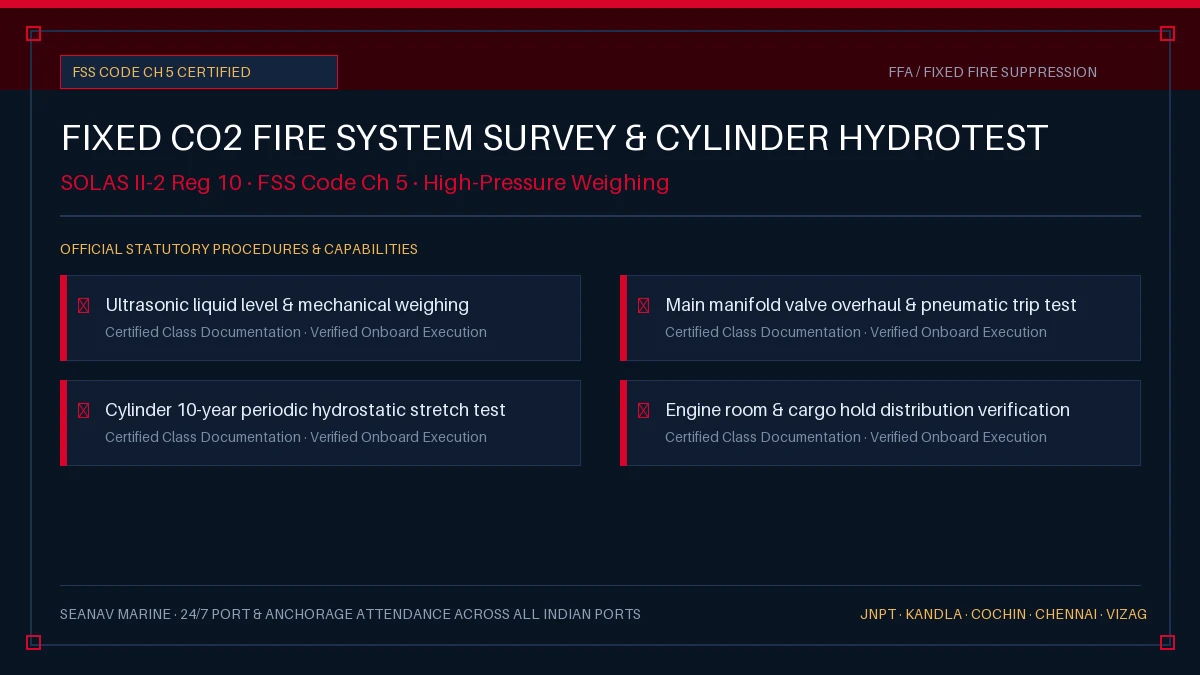
In accordance with SOLAS Chapter II-2 (Regulation 10), the FSS Code (Chapter 5), and IMO MSC.1/Circ.1318 / MSC.1/Circ.1432, high-pressure fixed carbon dioxide (CO2) fire suppression systems safeguarding ship engine rooms, pump rooms, and cargo holds must undergo rigorous annual inspections, 2-year blow-through testing, and statutory 10-year cylinder hydrostatic pressure testing.
Engineering Overview & Table of Contents
- 1. Regulatory Framework: IMO MSC.1/Circ.1318 Compliance
- 2. CO2 Cylinder Liquid Level Weighing & Ultrasonic Testing
- 3. 10-Year Cylinder Hydrostatic Testing & Burst Disc Renewal
- 4. Manifold Overhaul, Pilot Lines & Distribution Blow-Through
- 5. Pre-Discharge Alarms, Fan Stops & Ventilation Damper Interlocks
- 6. Statutory Class Certification Across Indian Shipyards & Ports
1. Regulatory Framework: IMO MSC.1/Circ.1318 Compliance
High-pressure carbon dioxide systems remain the primary total-flooding fire extinguishing mechanism for machinery spaces of Category A. Because CO2 is a lethal asphyxiant discharging at high pressure (approx. 50 bar at 20°C), system integrity must be proven without accidental release. Seanav is fully class-approved to deliver Fixed CO2 Fire-Fighting System Supply, Fixed CO2 System Installation, Fixed CO2 System Annual Inspection, and complete overhaul management.
2. CO2 Cylinder Liquid Level Weighing & Ultrasonic Testing
SOLAS dictates that if any CO2 cylinder exhibits a loss of content exceeding 10%, it must be refilled or replaced immediately. Traditional mechanical crane weighing is labor-intensive and poses risks to copper pilot loops. Seanav utilizes calibrated Ultrasonic Liquid Level Measurement instruments:
Non-Destructive Ultrasonic Liquid Level Protocol:
- Transducer Acoustic Coupling: Applying ultrasonic gel along the cylinder body to locate the exact liquid-vapor interface boundary.
- Temperature Correction: Cross-referencing ambient room temperature against cylinder surface temperature to determine precise liquefied CO2 mass density.
- Direct Crane Weighing Verification: Using calibrated digital load cells to mechanically verify boundary readings across random sample cylinders.
- CO2 Cylinder Refilling & Recharging: Extracting depleted cylinders to Seanav shore refilling depots, replacing valve seats, and recharging with food-grade industrial liquid CO2.
3. 10-Year Cylinder Hydrostatic Testing & Burst Disc Renewal
Under revised IMO MSC.1/Circ.1318 guidelines, at the 10-year survey interval, at least 10% of the total complement of CO2 cylinders must be removed from the vessel and subjected to internal hydraulic pressure testing. If one cylinder fails, an additional 50% must be tested; if a second fails, 100% of the installation must be hydrotested. At the 20-year survey, all remaining cylinders must undergo hydrostatic re-qualification.
| Test Stage | Test Specification | Engineering Scope |
|---|---|---|
| Hydrostatic Stretch Test | 250 bar (test pressure) held for 30 seconds | Water-jacket volumetric expansion test; permanent expansion must not exceed 10% of total expansion. |
| Internal Endoscope Inspection | Zero internal pitting, corrosion scale, or foreign debris | Video borescopic examination of cylinder internal neck threads and walls. |
| Valve Overhaul & Burst Disc | Safety rupture disc rating: 190 bar ± 10% | Renewing brass valve spindle seals, replacing safety burst discs, and fitting new copper sealing washers. |
4. Manifold Overhaul, Pilot Lines & Distribution Blow-Through
Blockages or corrosion debris inside discharge piping can choke flow during a critical machinery space fire. Our engineers execute thorough physical maintenance:
- Pneumatic Release Line Blow-Through: Disconnecting pilot lines from cylinder head release actuators and blowing through low-pressure dry air/nitrogen to clear moisture and dust.
- Discharge Manifold Inspection & Pressure Testing: Inspecting high-pressure manifold headers, testing non-return check valves (NRVs), and verifying high-pressure flexible discharge hoses for outer braid fraying or rubber embrittlement.
- Distribution Piping Blow-Through: Disconnecting main distribution piping from cylinder battery manifolds and blowing through compressed air to verify clear passage through all open discharge nozzles in the engine room and cargo spaces.
5. Pre-Discharge Alarms, Fan Stops & Ventilation Damper Interlocks
The release of CO2 must automatically trigger vital safety interlocks to ensure personnel evacuation and seal the space to sustain extinguishing gas concentration:
- CO2 Release Cabinet Door Switches: Verifying that opening the CO2 release cabinet door immediately trips the engine room visual and audible pre-discharge alarms.
- Pneumatic Time Delay Units: Testing mechanical or pneumatic delay timers (typically 20–30 seconds) ensuring personnel can escape before gas discharge begins.
- Ventilation Damper Tripping & Fuel Quick-Closing Valves: Verifying pneumatic pressure switches trigger automatic machinery ventilation fan shutdown, fire damper closure, and fuel pump trips.
6. Statutory Class Certification Across Indian Shipyards & Ports
Seanav coordinates comprehensive turnkey CO2 surveys, shore hydrotesting, and cylinder re-installations during vessel drydockings or cargo operations across Kandla, Mundra, Sikka, Mumbai, JNPT, Mangalore, Cochin, Chennai, Kakinada, and Visakhapatnam.
Schedule Your Fixed CO2 System Survey or 10-Year Hydrotest
Read detailed technical specifications on our Fixed CO2 Fire Suppression Commercial Hub or book an inspection team at any Major Indian Port.