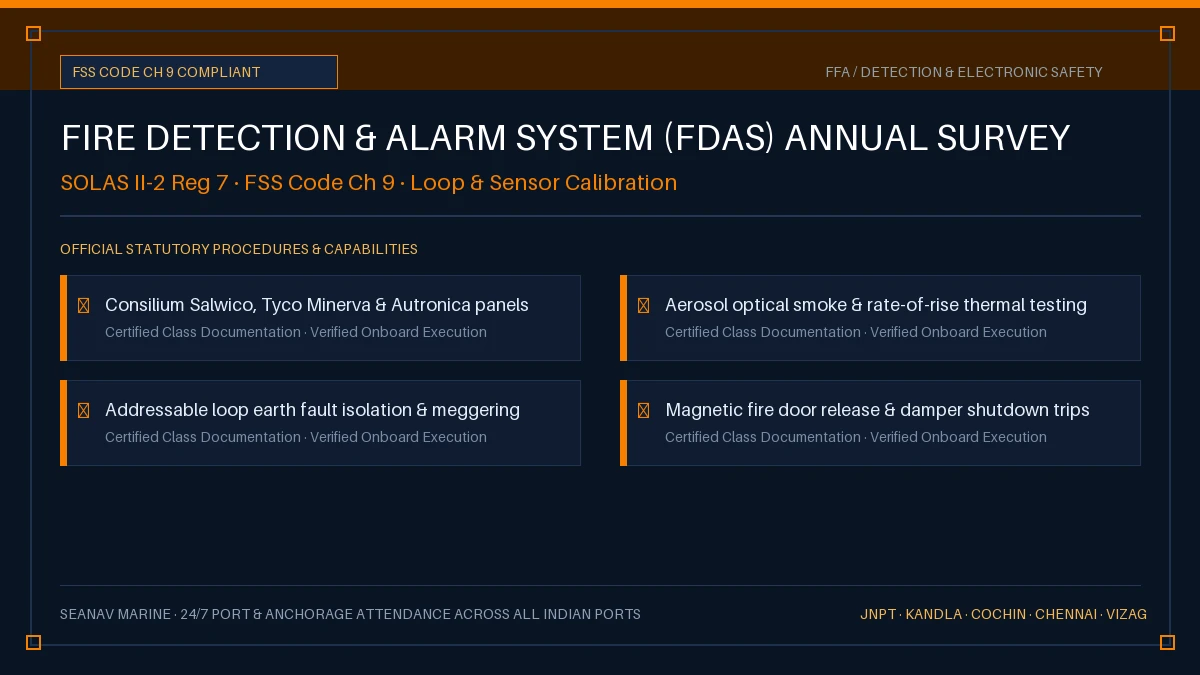
In compliance with SOLAS Chapter II-2 (Regulation 7) and the FSS Code (Chapter 9), fixed fire detection and fire alarm systems (FDAS) safeguarding vessel accommodation spaces, machinery rooms, and cargo holds must undergo comprehensive annual surveys and periodic sensitivity calibrations. Rapid, error-free fire detection prevents catastrophic incidents at sea.
Engineering Overview & Table of Contents
- 1. Statutory Guidelines: FSS Code Chapter 9 Standards
- 2. Addressable vs. Conventional Marine Fire Panels
- 3. Loop Diagnostics: Earth Faults, Short Circuits & Megger Testing
- 4. Sensor Verification: Smoke, Heat, Flame & Manual Call Points
- 5. Cause-and-Effect Interlocks: Fire Doors, Ventilation & Dampers
- 6. Statutory Surveys & Emergency Repairs Across UAE Ports
1. Statutory Guidelines: FSS Code Chapter 9 Standards
Modern ships utilize sophisticated addressable fire detection networks capable of pinpointing the exact cabin, deck, or engine room compartment where smoke or heat is detected. Seanav provides certified Fire Detection System Supply, Addressable Fire Alarm System Supply, Conventional Fire Alarm System Supply, and statutory Fire Detection System Inspection across Consilium, Tyco / Johnson Controls (Minerva Marine), Autronica, Salwico, and Hochiki systems.
2. Addressable vs. Conventional Marine Fire Panels
Seanav engineers service both contemporary digital addressable systems and traditional zoned conventional panels:
- Addressable Fire Alarm Panels: Microprocessor-controlled loops supporting up to 250 individual sensors per loop with bi-directional digital telemetry, individual sensor address reporting, and adjustable day/night sensitivity thresholds.
- Conventional Zoned Systems: Resistance-monitored 2-wire zones (typically 8 to 32 zones) with end-of-line (EOL) resistors, ideal for smaller tugboats, barges, and coastal cargo craft.
- Emergency Fire Alarm Panel Repair: Main processing board repair, LCD display module renewal, power supply unit (PSU) stabilization, and loop driver replacement.
3. Loop Diagnostics: Earth Faults, Short Circuits & Megger Testing
Marine vibration and moisture condensation often cause difficult intermittent loop faults. Seanav engineers utilize specialized test equipment to trace wiring anomalies:
Loop Testing & Electrical Diagnostic Protocol:
- Earth Fault Localization: Measuring positive and negative loop rail impedance to vessel ground hull structure; isolating individual zone segments until ground faults are cleared.
- Short-Circuit Isolator Testing: Verifying that bi-directional loop isolators activate during wiring short circuits, maintaining communication with all sensors on both sides of the fault.
- Cable Insulation Resistance (Megger Test): Megger testing fire-retardant screened twisted-pair cabling at 250V/500V DC (specification > 20 MOhm) after disconnecting sensitive loop cards.
- Battery Reserve Capacity Verification: Load testing 24VDC sealed lead-acid backup batteries to guarantee 24 hours of supervisory standby followed by 30 minutes of continuous alarm bells.
4. Sensor Verification: Smoke, Heat, Flame & Manual Call Points
During the annual survey, all accessible detectors must be physically tested for operational sensitivity and proper bridge alarm response:
| Detector Category | Test Methodology | Verification Criteria |
|---|---|---|
| Optical Smoke Detectors | Aerosol test smoke delivery via telescopic poles (Solo 330) | Alarm trigger within 20 seconds; optical chamber LED confirmation; panel address check. |
| Thermal Heat Detectors | Calibrated hot-air cordless test cup (Solo 461) | Fixed temperature trip (approx. 57°C–75°C) and rate-of-rise thermal circuit activation. |
| UV/IR Flame Detectors | Calibrated optical test lamp | Fast response verification in machinery spaces, separator rooms, and paint lockers. |
| Manual Call Points (Break Glass) | Mechanical test key release | Instant audible alarm initiation and master panel annunciator indication. |
5. Cause-and-Effect Interlocks: Fire Doors, Ventilation & Dampers
An effective marine fire alarm system must automatically coordinate emergency containment measures. Seanav technicians test all programmed cause-and-effect matrix relays:
- Magnetic Fire Door Holders: Verifying instant 24V release and positive mechanical latching of all fire zone barrier doors.
- Ventilation Damper Shutdown: Testing pneumatic and motorized fire damper release relays across galley exhausts, engine room intakes, and accommodation ventilation shafts.
- Engine Room Fan Stops: Verifying interlock trips to forced draft fans, boiler supply fans, and oily fuel separator room ventilation.
6. Statutory Surveys & Emergency Repairs Across UAE Ports
Seanav provides 24/7 flying squad attendance across all major UAE ports, carrying spare optical detectors, heat sensors, loop isolators, manual break-glass units, and replacement control circuit boards for immediate rectification of Class or Port State Control fire alarm deficiencies.
Schedule Fire Detection Annual Survey or Panel Troubleshooting
Explore our complete fire safety engineering scope on our Fire Detection & Alarm System (FDAS) Hub or contact our technical team for boarding at any Indian Commercial Port.