Description
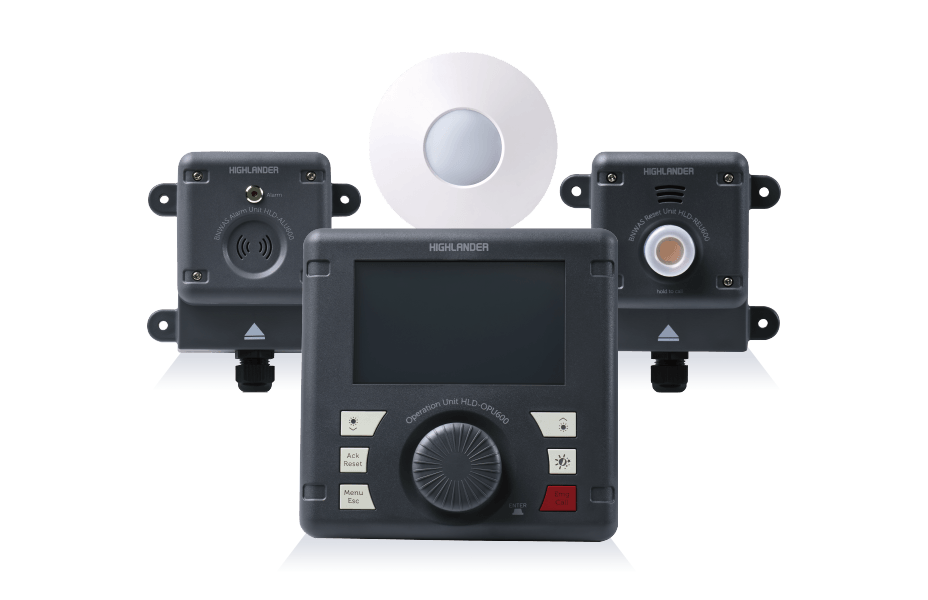
Highlander HLD-BNWAS 600 Bridge Navigational Watch Alarm System
The Highlander HLD-BNWAS 600 is a second-generation Bridge Navigational Watch Alarm System engineered to enhance maritime safety by continuously monitoring bridge activity and the alertness of the Officer of the Watch (OOW). Should the OOW become unable to perform assigned duties for any reason, the system automatically initiates an alert to the master or another qualified OOW, thereby reducing the risk of navigational incidents at sea.
This advanced BNWAS solution is fully compliant with IMO regulations and classification society requirements, making it suitable for installation across all vessel types. Designed with operational reliability and ease of use in mind, the HLD-BNWAS 600 integrates seamlessly with existing shipboard systems including autopilots, GPS, radar, and ECDIS.
System Overview & Engineering Architecture
The HLD-BNWAS 600 operates on a dual power supply architecture, supporting both main AC power (110/220 V, 50 Hz) and emergency DC power (24 V) with automatic switching capability. The system consumes less than 30 W, ensuring minimal impact on vessel energy resources. Its modular design allows flexible integration with external devices via IEC 61162 serial communication or dry-contact inputs.
The core unit features an 800×480 high-resolution color touch screen that supports both touch-screen and physical button operation, providing redundancy and enhanced human-machine interaction. The interface includes day and night display modes to accommodate varying lighting conditions during extended voyages.
Core Features & Operational Advantages
- Dual-Mode Touch Screen: 800×480 high-resolution color display supporting both touch and physical button operation.
- Day/Night Display Modes: Optimized visual presentation for day and night navigation environments.
- Revolving Warning Light: Provides clear visual alarm indication visible from multiple angles.
- Visual-Audible Reset Unit: Combines audible and visual feedback for reset confirmation.
- High-Sensitivity Motion Sensor: Detects OOW presence and activity levels accurately.
- Two-Stage Alarm Design: Supports individual call and simultaneous call configurations.
- Optional Battery Unit: Ensures continued operation during main power failure.
- IEC 61162 / Dry-Contact Input: Flexible connectivity options for external device integration.
- Main Control Unit with integrated touch screen display
- Reset Unit with visual and audible indicators
- Motion Sensor for OOW detection
- Revolving Warning Light assembly
- Optional Battery Backup Unit
- Interface modules for autopilot, GPS, radar, and ECDIS connectivity
- IMO MSC.128(75): International Maritime Organization performance standard for BNWAS.
- IEC 62616-2010: International Electrotechnical Commission standard for bridge navigational watch alarm systems.
- IEC 60945 ed.4.0:2002: EMC/EMI standard for maritime navigation and radio communication equipment.
- IMO SOLAS Chapter V requirements for BNWAS functionality
- Classification society survey schedules (e.g., DNV, ABS, Lloyd’s Register)
- Manufacturer-recommended service intervals
Component Breakdown & Technical Specifications
The HLD-BNWAS 600 system consists of the following key components:
| Parameter | Specification |
|---|---|
| Performance Standards | MSC.128(75); IEC 62616-2010, etc. |
| EMC/EMI Standard | IEC 60945 ed.4.0:2002 |
| Power Supply | Main supply AC 110/220 V, 50 Hz and emergency supply DC 24 V, dual-input automatic switching; power consumption < 30 W |
| Inputs | Autopilot, GPS, Radar, ECDIS (digital signal or contact signal) |
| Output | VDR (digital signal); other alarm system (alarm signal and/or system failure alarm) |
| Reset Interval | 3–12 min adjustable |
| Display | 800 × 480 high-resolution colour touch-screen |
| Operation Mode | Dual-mode: touch-screen and physical-button |
| Display Modes | Day/Night switchable |
| Alarm Indicator | Revolving warning light |
| Reset Unit | Visual-audible integrated reset unit |
| Motion Detection | High-sensitivity motion sensor |
| Alarm Design | Two-stage alarm with individual and simultaneous call support |
| Battery Option | Optional battery unit available |
| External Interface | IEC 61162 / Dry-contact input |
SOLAS, IMO, IEC & Classification Society Compliance
The Highlander HLD-BNWAS 600 meets international maritime safety standards, including:
These certifications ensure that the HLD-BNWAS 600 satisfies the stringent requirements set forth by maritime authorities such as the Federal Transport Authority (FTA) in the UAE, as well as classification societies including DNV, ABS, and Lloyd’s Register. The system is approved for installation on all vessel types operating under SOLAS Chapter V regulations.
Onboard Maintenance & Inspection Standards
To maintain optimal performance and regulatory compliance, the HLD-BNWAS 600 should undergo regular inspection and maintenance in accordance with:
Routine checks should include verification of motion sensor sensitivity, alarm functionality, reset interval settings, and power supply redundancy. The optional battery unit must be inspected periodically to ensure backup power availability during emergencies.
For vessels calling at major regional ports such as Jeddah Port, Yanbu Port, or Port Said Port, Seanav Marine provides certified technicians trained in BNWAS commissioning, calibration, and repair services.
Technical Support & Port Delivery Call to Action
Seanav Marine offers comprehensive technical support for the Highlander HLD-BNWAS 600, including installation guidance, system integration, crew training, and ongoing maintenance services. Our team of marine electronics specialists ensures seamless deployment across fleets operating in UAE waters and beyond.
We also provide related services such as VDR/S-VDR Annual Performance Testing, GMDSS Radio Survey Preparation, and Marine Gyrocompass Overhaul.
For inquiries regarding pricing, availability, or technical consultation, please contact our technical team at Contact Seanav Marine Technical Team.
<
Frequently Asked Questions
Frequently Asked Questions
Q1: What is the primary function of the Highlander HLD-BNWAS 600?
A: The HLD-BNWAS 600 monitors bridge activity and the alertness of the Officer of the Watch (OOW). If the OOW becomes unable to perform duties, it automatically alerts the master or another competent OOW to prevent maritime accidents.
Q2: Is the HLD-BNWAS 600 compliant with IMO standards?
A: Yes, the system complies with IMO MSC.128(75) and IEC 62616-2010 standards, ensuring adherence to international maritime safety regulations.
Q3: What type of display does the HLD-BNWAS 600 feature?
A: It includes an 800×480 high-resolution color touch screen that supports both touch-screen and physical button operation in dual-mode configuration.
Q4: Can the system operate during a main power failure?
A: Yes, the HLD-BNWAS 600 supports dual-input automatic switching between main AC power (110/220 V) and emergency DC power (24 V). An optional battery unit is also available for extended backup.
Q5: What external systems can the HLD-BNWAS 600 interface with?
A: The system accepts inputs from autopilot, GPS, radar, and ECDIS via digital signal or contact signal, and provides output to VDR and other alarm systems.
Q6: How is the alarm reset interval configured?
A: The reset interval is adjustable between 3 and 12 minutes, allowing customization based on vessel operational requirements.
Q7: Does the HLD-BNWAS 600 support both individual and group alarm calls?
A: Yes, it features a unique two-stage alarm design that supports both individual call and simultaneous call functions.
Q8: What EMC/EMI standards does the HLD-BNWAS 600 meet?
A: The system meets IEC 60945 ed.4.0:2002 standards for electromagnetic compatibility and interference in marine environments.
Q9: Can the HLD-BNWAS 600 be installed on all vessel types?
A: Yes, the system is designed for installation on all types of vessels and complies with classification society rules and SOLAS Chapter V requirements.
Q10: Where can I get technical support for the HLD-BNWAS 600?
A: Seanav Marine provides full technical support including installation, integration, maintenance, and repair services. Visit Contact Seanav Marine Technical Team for assistance.
Technical Specifications & Operational Standards
Review certified engineering parameters, electrical inputs, data protocols, and Class compliance standards for this unit:
| OEM Brand / Manufacturer | Highlander |
|---|---|
| Model / Part Number | SEANAV-NAV-BNWAS-600 |
| Equipment Classification | Commercial Marine Navigation & Communication Spares |
| Operating Conditions | -15°C to +55°C Industrial Marine Deck / Wheelhouse Environment |
| Quality Standard | OEM Marine Grade, Factory Bench Verified Ahead of Dispatch |
| Stock & Port Logistics | Ready Stock for Immediate Vessel Supply across Mumbai, JNPT, Kandla, Cochin, Chennai & Visakhapatnam |
| In-the-Box Documentation | OEM Certificate of Conformance, Wiring Schematics, Installation & Operating Manual |
Seanav Marine maintains bonded warehouse spare parts inventory and factory-trained technical riding squads across all major Indian ports. Immediate dispatch available to vessel agents, ship chandlers, and technical managers at Mumbai, JNPT (Nhava Sheva), Kandla, Mundra, Cochin, Chennai, and Visakhapatnam (view all 400+ ports →).